Overview
Work-related skin problems are very common. They can happen in most workplaces although they happen more in certain high-risk jobs. They can be very costly, not just through the suffering individuals experience (which can lead to ending their careers), but also because they can be a burden for employers who are left with sickness absence, recruitment, training and compensation expenses.
What are work-related skin problems?
Work-related skin problems are caused or made worse by exposure to/coming into contact with substances such as chemicals, and also through having wet hands for long periods, while at work. Dermatitis (also known as eczema) is by far the most common, but urticaria and skin cancer are also problems. Exposure to the sun can also cause problems.
What should I do about it?
The good news is that although these problems are common they are preventable. There are simple, cost-effective steps employers and workers can take to avoid skin problems at work, and to manage them if they do happen, using the Avoid, Protect and Check approach.
Dermatitis
What is dermatitis?
Dermatitis is a skin condition caused by contact with something that irritates the skin or causes an allergic reaction. It usually occurs where the irritant touches the skin, but not always.
What does it look like?
If you look at pictures of skin that has dermatitis, you could see one or all of these signs:
- Redness
- Scaling/flaking
- Blistering
- Weeping
- Cracking
- Swelling
What does it feel like?
Someone who has dermatitis may experience symptoms of itching and pain. The signs and symptoms of this condition can be so bad that the sufferer is unable to carry on at work. We have provided some case studies to give you the chance to see and hear real-life examples of dermatitis and how they were managed.
What causes irritant contact dermatitis?
It can occur quickly after contact with a strong irritant, or over a longer period from repeated contact with weaker irritants. Irritants can be chemical, biological, mechanical or physical. Repeated and prolonged contact with water (eg more than 20 hand washes or having wet hands for more than 2 hours per shift) can also cause irritant dermatitis.
What causes allergic contact dermatitis?
This can occur when the sufferer develops an allergy to a substance. Once someone is 'sensitised', it is likely to be permanent and any skin contact with that substance will cause allergic contact dermatitis. Often skin sensitisers are also irritants.
These are some of the more common causes of irritant and allergic contact dermatitis:
Irritant contact dermatitis
- Wet work
- Soaps, shampoos and detergents
- Solvents
- Some food (eg onions)
- Oils and greases
- Dusts
- Acids and alkalis
- Wet cement
Allergic contact dermatitis
- Some hair dyes
- UV cured printing inks
- Adhesives
- Nickel
- Some plants (eg chrysanthemums)
- Colophony
- Certain wood dusts
Urticaria
What is urticaria?
Urticaria is a skin condition caused by contact with something that irritates the skin or causes an allergic reaction. Contact urticaria is different from dermatitis. In particular, it usually occurs quickly following skin contact and disappears again within hours. Common causes of urticaria are:
- latex protein in single-use latex gloves;
- some foods (eg potatoes, fish, meat);
- cold or heat.
What does it look like?
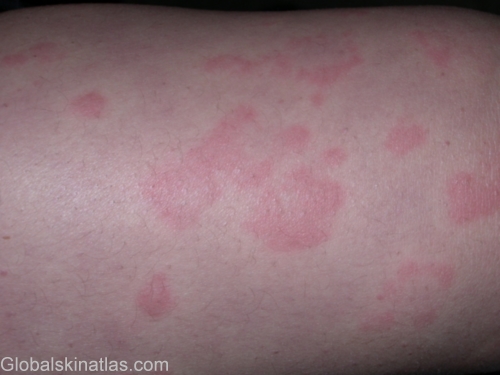
You could typically see a wheal (swelling) and flare (red mark) reaction.
What does it feel like?
Someone who has urticaria may suffer itching, tingling or burning sensations at the site of the rash.
Skin cancer
What is skin cancer?
Skin cancer is one of the most common types of cancer. While most skin cancer is not to do with work, there are well-recognised causes for those that are linked with occupation. The most common causes of work-related skin cancers are:
- ultraviolet light (mainly from natural sunlight, not exclusively to do with work, but is significant for those who work outdoors);
- ultraviolet light from sunbeds (where there may be a risk for sunbed operators and their employees). Please refer to our guidance on sunbeds for further details.
- some chemicals (such as polycyclic aromatic hydrocarbons [PAHs] from coal tar, pitch and unrefined mineral oils);
- ionising radiation (eg from radioactive substances and X-rays).
Some substances can get in through the skin and cause cancers in other parts of the body.
What does it look like?
There is a range of signs linked with skin cancer eg a scaly patch of hard skin, a red lump or spot, an ulcer, a new mole, or a patch of skin which bleeds, oozes or has a crust.
Outdoor workers and sun exposure
What is the problem?
Too much sunlight is harmful to your skin. A tan is a sign that the skin has been damaged. The damage is caused by ultraviolet (UV) rays in sunlight.
Who is at risk?
If work keeps you outdoors for a long time your skin could be exposed to more sun than is healthy for you. Outdoor workers that could be at risk include farm or construction workers, market gardeners, outdoor activity workers and some public service workers. If you have naturally brown or black skin, you are less at risk of skin cancer, although cases do occur. Therefore, when the sunlight is intense, it would be sensible if you also followed the guidance below to protect yourself. You should take particular care if you have:
- fair or freckled skin that doesn't tan, or goes red or burns before it tans;
- red or fair hair and light coloured eyes;
- a large number of moles.
What are the harmful effects?
In the short term, even mild reddening of the skin from sun exposure is a sign of damage. Sunburn can blister the skin and make it peel.
Longer term problems can arise. Too much sun speeds up ageing of the skin, making it leathery, mottled and wrinkled. The most serious effect is an increased chance of developing skin cancer.
What can you do to protect yourself?
- Keep your top on.
- Wear a hat with a brim or a flap that covers the ears and the back of the neck.
- Stay in the shade whenever possible, during your breaks and especially at lunch time.
- Use a high factor sunscreen of at least SPF15 on any exposed skin.
- Drink plenty of water to avoid dehydration.
- Check your skin regularly for any unusual moles or spots. See a doctor promptly if you find anything that is changing in shape, size or colour, itching or bleeding.
Where can you get further information?
The following free leaflets have been produced by HSE:
The following website also provides useful information: